The Parent Playbook

Games for your child + a Playbook for you

Games train attention online. The Playbook makes the home environment right, offline — sleep, study space, movement, screens and more. Each week you get two or three small plays to try, with a one-tap "We did it".

Sleep & screens

Sleep & screens

Protect the sleep window

Teens are advised to get 8–10 hours of sleep, and late screens make it easy to lose. Agree a window together rather than setting it for them.

Source: American Academy of Sleep Medicine, recommended sleep for children and teens (2016)

This week

  1. Ask your teen what time they need to wake on school days.
  2. Count back 8–10 hours together to find a lights-out time.
  3. Agree where phones charge overnight — outside the bedroom works for many families.

Offline together: Set up a shared family charging spot in the kitchen or hallway.
Sleep & screens

Screens-down hour

A simple family rule about screens before bed removes the nightly negotiation.

Source: American Academy of Pediatrics, Family Media Plan

This week

  1. Choose a time when screens go down for everyone, grown-ups included.
  2. Put a gentle alarm on one shared device as the signal.
  3. Swap in something calm: a book, music, a bath or a chat.

Offline together: Try a 'lights low' evening: lamps only, a card game, then bed.

Study space & routine

Study space & routine

One study spot

A fixed spot with the right things ready means less hunting and fewer reasons to drift away.

This week

  1. Choose one spot together — kitchen table counts.
  2. Stock a small box: pencils, ruler, eraser, paper, water bottle.
  3. Keep phones and tablets out of reach during study time.

Offline together: Decorate the study box together and label what lives in it.

Study space & routine

Sunday ten-minute plan

Seeing the week's deadlines in one place makes the big things less of a surprise. Let them own the plan; you just ask.

This week

  1. On Sunday, ask your child to list this week's deadlines and tests.
  2. Help them put each one in the Study Planner or a paper calendar.
  3. Mid-week, ask one question: "What's next on your plan?"

Offline together: Share your own week's plan at the same time — model it, don't lecture it.

Homework start

Homework start

Just the first five minutes

Starting is often the hardest part. An if–then plan ("when I sit down, I'll do the first question") makes starting more automatic.

Source: Gollwitzer, if–then plans (1999)

This week

  1. Agree a start cue: "When the snack's done, I open my book."
  2. Set a five-minute timer — they only promise five minutes.
  3. When it rings, they choose: stop or keep going.

Offline together: Play 'beat the timer' with a chore — tidy one shelf in five minutes together.

Homework start

Chunk it down

A big task feels lighter as a short list of small, clear steps.

This week

  1. Ask your child to break tonight's work into three to five small steps.
  2. Tick each step off on paper as it's done.
  3. Take a two-minute stretch between chunks.

Offline together: Break a family job (making dinner, packing for a trip) into steps and tick them off together.

Movement & outdoor play

Movement & outdoor play

Move before homework

Children and teens aged 6–17 are advised to get about 60 minutes of activity a day. A burst before homework is an easy way to fit some in.

Source: CDC, physical activity for children and teens aged 6–17

This week

  1. Put 15 minutes of movement right after school.
  2. Let your child pick: scooter, ball, dance, a walk.
  3. Then start homework — no screens in between.

Offline together: A family walk after dinner with a 'spot five things' challenge.

Movement & outdoor play

Move side by side

Teens often talk more easily while walking or doing something side by side than face to face.

Source: CDC, physical activity for children and teens aged 6–17

This week

  1. Invite your teen to a walk, run, bike ride or gym session once this week.
  2. Let them choose the route or the music.
  3. Keep the talk light — no homework check-ins on the walk.

Offline together: Try a new sport or route together and let your teen be the expert.

Family games without screens

Family games without screens

Card game night

Card and board games ask everyone to wait their turn, remember rules and follow the play — and they're time together.

This week

  1. Pick one evening this week for a 20-minute game.
  2. Let your child teach a game they know.
  3. Keep score lightly — celebrate good moves, not just winners.

Offline together: Snap, Uno or Go Fish for younger ones; Spot It, Set or a strategy game for older ones.

Family games without screens

Strategy night

Strategy games reward planning ahead and changing tactics — and let older children beat their parents fairly.

This week

  1. Choose a strategy game: chess, a card game, or a co-op board game.
  2. Play best of three over the week.
  3. Ask your child to explain their winning move.

Offline together: Run a family chess or card tournament with a homemade trophy.

Conversations & praise

Conversations & praise

Praise the process

Praise aimed at effort and strategy, rather than being 'clever', is linked with children sticking with hard tasks.

Source: Mueller & Dweck, praise for effort vs. ability (1998)

This week

  1. Swap "you're so smart" for "you tried a new way".
  2. Name one specific thing they did: "you checked your work".
  3. Praise the practice streak, not the score.

Offline together: At dinner, everyone shares one thing they kept trying at today.

Conversations & praise

Curious questions

Open questions invite older children to think out loud instead of giving one-word answers.

This week

  1. Swap "how was school?" for "what was the hardest bit today?"
  2. Listen to the end before you suggest anything.
  3. Ask "what would you try next time?" rather than telling.

Offline together: Play 'two truths and a lie' about your days at dinner.

Conversations & praise

Talk like a teammate

Teens are building their own way of working. Asking how you can help usually lands better than telling them what to do.

This week

  1. Ask: "What's one thing I could do that would actually help this week?"
  2. Do exactly that one thing.
  3. At the end of the week, ask how it went.

Offline together: Cook a meal together where your teen is head chef and you're the assistant.

Phone & device rules

Phone & device rules

A phone agreement made WITH your teen

Rules a teen helped write are easier to keep than rules handed down. Use the agreement builder in the Teen zone to write it together.

Source: American Academy of Pediatrics, Family Media Plan

This week

  1. Ask your teen what they think is fair for study time, meals and night.
  2. Write three to five rules together in the Teen zone agreement.
  3. Agree a review date in a month — both of you can suggest changes.

Offline together: Both of you try one 'phone in another room' hour this week and compare notes.

Phone & device rules

Tidy the notifications

Fewer pings during study time means fewer interruptions to come back from.

This week

  1. Sit together and look at which apps send notifications.
  2. Let your child choose which ones to mute during study time.
  3. Try a 'study mode' or focus setting for homework hours this week.

Offline together: Do your own notification tidy at the same time and swap tips.

Reading together

Reading together

Read side by side

Older children often enjoy reading near someone rather than being read to. Quiet company counts.

This week

  1. Set 15 minutes where everyone reads their own book or article.
  2. Phones go in another room for those minutes.
  3. Afterwards, each person shares one interesting line.

Offline together: Visit the library or a bookshop and each pick something for the other.

Calm-down routines

Calm-down routines

Four-count breathing

A short breathing routine is a simple, portable way to pause before a hard task.

This week

  1. Practise together: breathe in for 4, hold for 4, out for 4, hold for 4.
  2. Do three rounds before homework or a test.
  3. Let your child lead it once this week.

Offline together: Draw a square and trace it with a finger while breathing round it together.

Calm-down routines

A reset plan for stressful days

Knowing in advance what helps on a bad day makes it easier to reach for when it's needed.

This week

  1. Ask your child what helps them reset: music, a walk, a shower, a snack.
  2. Write their top three on a note in their phone or room.
  3. On a tough day, point to the list instead of giving advice.

Offline together: Make a shared 'calm playlist' where everyone adds two songs.

Exam weeks

Exam weeks

Test, don't just reread

Practising recall — quizzing yourself — is one of the best-studied ways to revise, compared with reading notes again.

Source: Roediger & Karpicke, practice testing (2006)

This week

  1. Help your child turn notes into questions (the Revision Quiz Maker can help teens).
  2. Quiz in short sessions, answers covered.
  3. Revisit the ones they missed the next day.

Offline together: Turn revision into a family quiz show at dinner — they write the questions.

Exam weeks

Spread revision out

Spreading study over several days is linked with better recall than cramming it into one night.

Source: Cepeda et al., spaced practice (2006)

This week

  1. List the exams and dates with your child.
  2. Plan short sessions across the days before each one.
  3. Keep sleep and meals normal in exam week.

Offline together: Make an exam-week calendar together and add one fun thing to each day.

Exam weeks

The exam-morning routine

A practised routine for exam mornings removes last-minute decisions and rushing.

This week

  1. The night before: bag packed, clothes out, alarm set.
  2. Morning: breakfast, water, leave with time to spare.
  3. Skip last-minute cramming — a quick look at a summary sheet is plenty.

Offline together: Rehearse the routine on a normal day so exam day feels familiar.

Get this week's plays picked for your child's grade and your goals — plus the games.

Start free
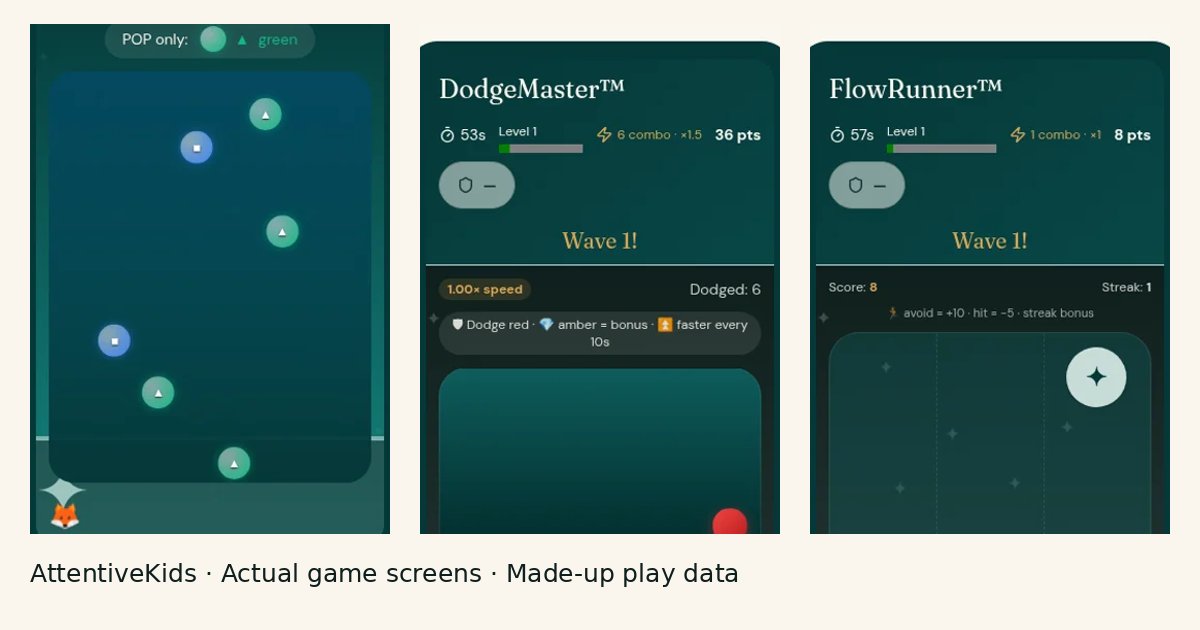
AttentiveKids actual game screens
Actual game screens · Any play data shown is made up for illustration.